Adaptation is still financed as a policy obligation. It needs to be financed as an investment category. That is the core shift emerging markets now need to make. The capital case is increasingly clear, but the market architecture is not. UNEP’s 2025 Adaptation Gap Report puts developing-country adaptation needs at US$310 billion to US$365 billion a year by 2035, while international public adaptation finance flows to developing countries were only US$26 billion in 2023. IFC makes the market failure even starker: adaptation and resilience is a trillion-dollar market opportunity, yet 98% of tracked adaptation finance is still dominated by public actors.
That is why the phrase “adaptation as an asset class” matters. It does not mean water systems, cooling infrastructure, or resilience investments suddenly behave like a single homogeneous pool of assets. It means investors need a repeatable way to underwrite them: clearer cash flows, better risk-sharing, stronger standards, and more bankable pipelines. The Global Center on Adaptation recognized this in late 2025 by launching the Investors Resilience Challenge to create a global standard for qualifying climate adaptation and resilience investments. The signal is important. The next phase is not about proving adaptation is necessary. It is about making it legible to capital.
The opportunity is largest where climate risk is already operating like a balance-sheet issue: water stress, extreme heat, and physical resilience of firms and infrastructure. These are not marginal externalities. They affect utility revenues, agricultural productivity, health-system loads, industrial continuity, labor productivity, and municipal service reliability. The World Bank’s new Water Strategy Implementation Plan is explicit that scaling water security will require coordinated public and private intervention, stronger sector performance, more creditworthy utilities and municipalities, and risk instruments that can crowd in commercial capital. It also notes that private sector participation accounts for only about 10% of water-sector capex, compared with about 90% in digital and 50% in transport and energy.
Why adaptation still fails to scale
The bottleneck is not just a shortage of money. It is a shortage of investable structures. Adaptation projects often lack one or more of the ingredients investors need: reliable revenue logic, standardized metrics, pipeline aggregation, risk mitigation, or credible sponsors. That is why adaptation remains overdependent on public balance sheets even when the economic case is compelling. IFC’s FY2025 climate disclosures show adaptation commitments of US$558 million with US$3.7 billion in total capital mobilized, which is progress, but still small relative to global need.
To move from projects to an asset class, emerging markets need to structure around four principles:
Revenue visibility through tariffs, availability payments, service contracts, user fees, or savings-linked models.
Credit enhancement through guarantees, concessional tranches, viability gap funding, or local-currency support.
Standardized qualification so resilience outcomes can be valued, monitored, and compared.
Aggregation so small and medium adaptation investments become investable pools rather than one-off transactions.
Water is the most obvious starting point
If adaptation is going to become an asset class in emerging markets, water will likely be the first large-scale proving ground. The World Bank’s Water Strategy now explicitly targets utility creditworthiness, cost-reflective tariffs, performance-based contracts, sub-sovereign financing, blue and green finance, and guarantees to mobilize private capital across the water value chain. This is the right direction because water already has the foundations of bankability: essential demand, measurable service outcomes, and established public-sector counterparties. What has been missing is not relevance, but structuring discipline.
There are practical templates already. The World Bank’s 2025 review of climate adaptation and nature-based infrastructure highlights Jordan’s As-Samra Wastewater Treatment Plant expansion, where a blended package combined US$93 million in viability-gap grant funding from the Millennium Challenge Corporation and US$20 million from the Government of Jordan to mobilize US$110 million in private financing from local banks and financial institutions. The report notes that this structure lowered capital costs and enabled long-tenor local-currency financing that had not previously been available at that maturity in Jordan. That is what an adaptation-relevant water asset class will require: public capital used not to replace private capital, but to make it investable.
The next frontier is water resilience with natural infrastructure embedded into the financing logic. The same World Bank report points to the Greater Cape Town Water Fund, where public and private contributors supported upstream watershed interventions; by 2025, the program had restored 34.53 billion liters per year to streams and generated a water-supply yield benefit of 18.17 billion liters per year for the City of Cape Town, alongside green jobs. GCA’s 2026 work reinforces why this matters: well-designed nature-based solutions can deliver benefit-cost ratios of 2:1 to 8:1, but remain underfunded because valuation, pipeline design, and financing structures are still weak. That is not a return problem. It is a market-design problem.
Heat finance is the next underbuilt market
Extreme heat is becoming one of the largest adaptation blind spots in emerging markets. It is already a productivity issue, a public-health issue, and an infrastructure issue. Yet it is still rarely financed as a dedicated investment category. The World Bank’s 2025 Cooler Finance report estimates that simply closing existing shortfalls in access to cooling in developing economies will require US$400 billion to US$800 billion, without even accounting for future demand growth. The same report argues that scaling sustainable cooling could cut consumers’ electricity bills by as much as US$5.6 trillion over the next 25 years, reduce the need for new power generation investment by US$1.8 trillion, and lower cumulative spending on cooling equipment by around US$800 billion.
That is a powerful investment case, but it does not automatically create an asset class. The World Bank also notes the barriers: affordability constraints, weak electricity access, technical-skills gaps, supply-chain limitations, and poor building-code environments. In other words, heat finance needs layered structuring. For middle-income commercial markets, that may mean cooling-as-a-service, energy-service contracts, or green real-estate lending. For lower-income households, schools, clinics, and SMEs, it will require concessional capital, aggregation, and public support. World Bank urban heat guidance published in 2026 also makes clear that what is “typically financed” ranges from weather monitoring and heat-alert systems to cooling centers, cool spaces, occupational protections, and demand-reduction measures in buildings and public spaces. The market is broad enough. What it lacks is packaging.
Resilience finance needs to move through financial intermediaries
One of the fastest ways to scale adaptation as an asset class is through banks and development finance channels rather than project-by-project direct investment. The World Bank’s Financing Adaptation for Growth Project in Türkiye is an important signal. In 2025, the Bank approved a EUR 360 million guarantee for a project designed to mobilize up to EUR 600 million in private capital for firm-level adaptation measures, with TSKB using the guarantee-supported financing to establish a line of credit for eligible sub-loans. The project is positioned explicitly as a pilot to develop Türkiye’s adaptation finance market and demonstrate the commercial viability of resilience investments. That is exactly the kind of intermediation model emerging markets need more of.
The Ghana example points in the same direction. In November 2025, Fidelity Bank Ghana and the Global Center on Adaptation announced a partnership to accelerate private-sector adaptation investment, including internal masterclasses on adaptation finance, technical assistance for Green Climate Fund mobilization, and integration of adaptation and resilience into the bank’s client offerings. GCA also said its Africa Adaptation Acceleration Program is on track to have climate-proofed nearly US$25 billion in investments across 30 African countries by the end of 2025. This matters because adaptation will not become an asset class only through sovereign issuance or MDB lending. It will also grow through domestic financial institutions that learn how to originate, structure, and distribute resilience-linked assets.
What leaders should do now
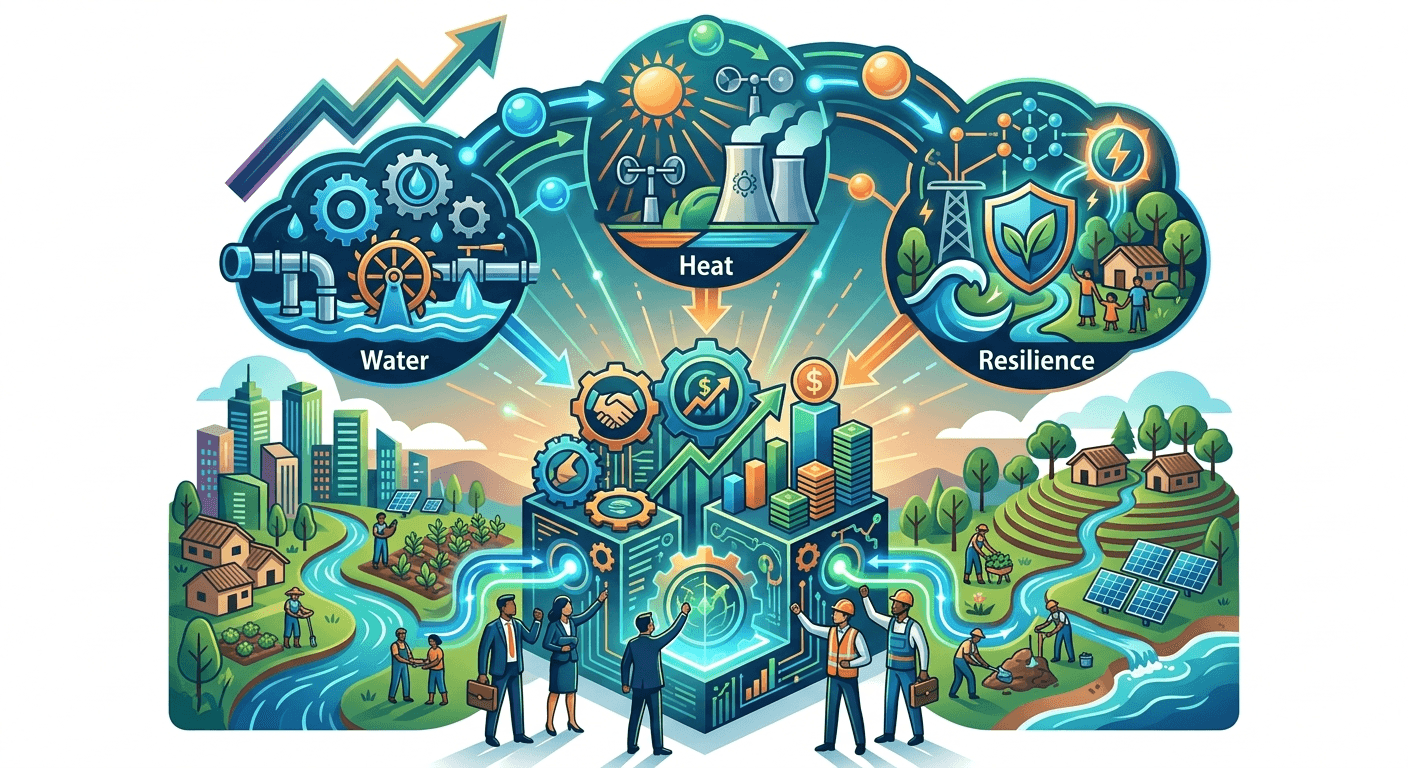
The winning strategy is not to treat adaptation as one more ESG category. It is to build three distinct pipelines.
First, water pipelines should be structured around utility reform, credit enhancement, tariff visibility, and blended finance. Second, heat pipelines should be aggregated around buildings, cooling access, and city-scale resilience programs rather than left as scattered social expenditures. Third, resilience-finance pipelines should move through banks, guarantees, and on-lending platforms that can scale smaller investments into bankable portfolios. Across all three, the prize is the same: convert avoided losses and resilience benefits into investable cash-flow logic.
The real insight is simple. Adaptation does not need more advocacy to become an asset class. It needs better structuring. The emerging markets that solve that problem first will not just attract more capital. They will build a competitive advantage in resilience itself.